now booking 2026 speaking dates

ARTS IN HEALTH | CREATIVE ENGAGEMENT | APPLIED RESEARCH
What happens when we take creative engagement seriously as part of human wellbeing?
HUMAN-CENTERED CHANGE THROUGH CREATIVITY
Culture shapes capacity.
Let’s build creative cultures
where people thrive.
I help people and organizations restore
what makes them thrive: creativity, connection, and meaning.
Creativity is a lifeline, not a luxury.
Free 3-minute diagnostic
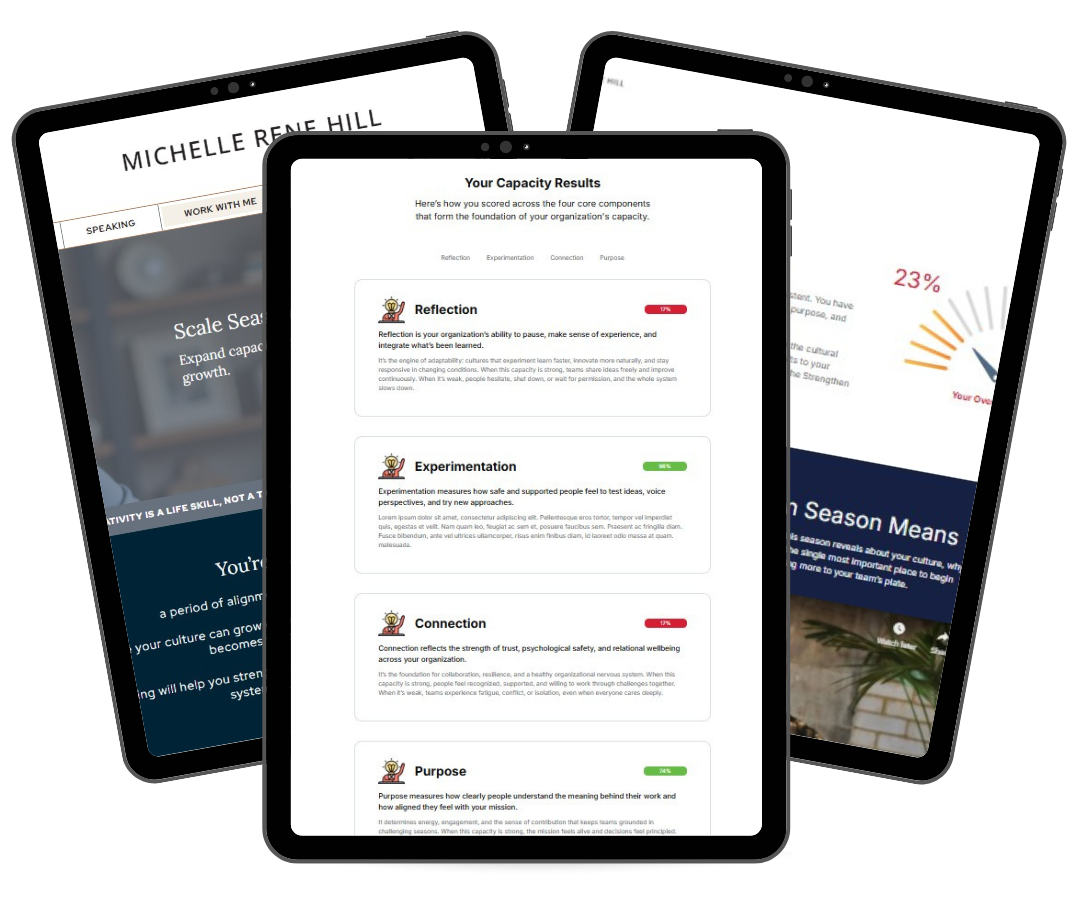
Is Your Culture Draining your team?
Before you can rebuild capacity, you need to know where it’s leaking.
In this quick, research-informed snapshot, you’ll see how well your organization supports the conditions that keep people clear, connected, and grounded in purpose. In just a few minutes, you’ll see:
Where you're losing creative, emotional, and relational capacity
Whether you're operating in Survival, Maintenance, or Growth mode
How your current patterns may be fueling burnout or fragmentation
One practical next step to rebuild capacity without adding more work
Instant results on-screen
Praesent mattis, ipsum sit amet placerat dapibus, est eros tempor neque, nec elementum dui ipsum non elit. Curabitur feugiat lacinia orci, non rutrum quam dignissim ac. Donec laoreet bibendum ligula, ullamcorper consectetur dolor
JANE AWESOME, ACME CO.
A note about the work
I’m currently completing an M.A. in Arts in Medicine at the University of Florida, where my research explores how creative engagement operates, what conditions support meaningful participation, and how arts-based practices can be translated into community settings.
I came to graduate study after decades of work in facilitation, writing, business and nonprofit leadership, program development, and creative practice. That background shapes the questions I ask.
Current Research Orientation
My work currently centers on three connected questions: how people engage with creative experiences; how arts-based practices may support wellbeing, attention, connection, and meaning-making; and how research can be translated into programs and frameworks that work in real community settings.
Where I'm Headed
I’m especially interested in research that sits between theory and practice: developing and testing models, studying implementation and feasibility, and working with organizations to understand how creative engagement can be responsibly adapted across different populations and settings.
Current Investigations
1
Aesthetic Engagement
I’m developing the Aesthetic Engagement Model, which proposes that meaningful arts engagement is better understood by the depth of a person’s internal response than by whether an activity is labeled “active” or “receptive.” The model examines attention, affect, meaning-making, expression, and the conditions that shape engagement.
2
Nature Journaling and Arts in health
My recent literature review examined nature journaling as an arts in health practice, focusing on attention, reflective and multimodal expression, and connection to self, others, and place. The existing evidence suggests promising theoretical alignment with arts in health mechanisms while also revealing clear gaps for future research.
3
Make-Break-Transform Framework Development
I’m leading the formal development of Athentikos’ Make-Break-Transform framework, documenting 15 years of practice, clarifying its core and adaptable elements, building its research base and theory of change, and identifying future directions for evaluation and study.
4
Arts, Disaster & Community Resilience
I’m exploring how community arts and cultural assets may contribute to preparedness and long-term recovery, including questions about local capacity, cross-sector partnerships, and whether frameworks such as Make-Break-Transform can be responsibly studied or adapted in resilience settings.
Selected Research & Writing
What Is Engagement? Proposing the Aesthetic Engagement Model for Arts in Health
Independent study paper, University of Florida, 2026.
Proposes a model of aesthetic engagement based on the degree of internal response to an arts encounter rather than the usual active/receptive distinction.
Nature Journaling as an Arts in Health Practice: A Conceptual Review
Literature review, University of Florida, 2026
Examines nature journaling through an arts in health lens, focusing on attention, reflection, multimodal expression, and connection.
Seeing Creative Programming Differently
Developed at John P. Holt Brentwood Library, 2026
A field-based resource developed to help public-library programmers recognize and articulate the wellbeing outcomes already present in creative programming.
INTERESTED IN THIS WORK?
I’m open to conversations with researchers, practitioners, organizations, and funders working across arts, health, community practice, and resilience. If you’re exploring research collaboration, program development, or applied inquiry, I’d be glad to connect!
Praesent mattis, ipsum sit amet placerat dapibus, est eros tempor neque, nec elementum dui ipsum non elit. Curabitur feugiat lacinia orci, non rutrum quam dignissim ac. Donec laoreet bibendum ligula, ullamcorper consectetur dolor
JANE AWESOME, ACME CO.

Creativity isn’t a luxury,
it’s a lifeline.
Creativity isn’t self-indulgence, it’s how we stay human.
It restores connection where culture has created distance, meaning where systems have reduced us to output, and hope where urgency has taken root.
When we create, we remember who we are — and what we’re capable of becoming.
© COPYRIGHT 2026 Michelle Rene Hill | ALL RIGHTS RESERVED | TERMS AND CONDITIONS | CONTACT SUPPORT